
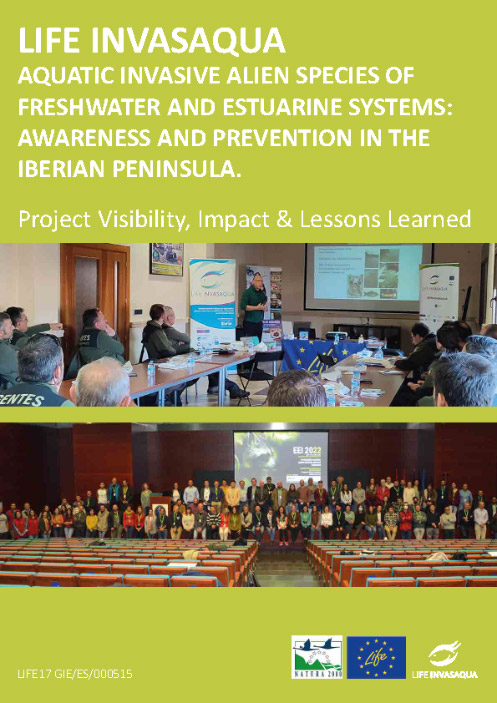
AQUATIC INVASIVE ALIEN SPECIES OF FRESHWATER AND ESTUARINE SYSTEMS: AWARENESS AND PREVENTION IN THE IBERIAN PENINSULA Project Visibility, Impact & Lessons Learned
Biological invasions are one of the major drivers of global change that threatens biodiversity, ecosystem services, and human health (IPBES 2023). Increasing rates of species introductions (Seebens et al. 2017), climate change (Gallardo et al. 2018) and other anthropogenic influences, such as globalisation as well as human-altered habitats, favour the establishment and spread of alien species (Hulme 2021).
According to the European Commission, Invasive Alien Species (IAS) are defined as species, subspecies or lower taxa whose introduction and spread outside their natural ecological range have been found to threaten or adversely impact to biodiversity and relative ecosystem services (EU Regulation 1143/2014). The introduction of IAS can alter ecosystems and are one of the main anthropogenic global drivers of species extinctions, incurring high economic costs (Diagne et al. 2021).

